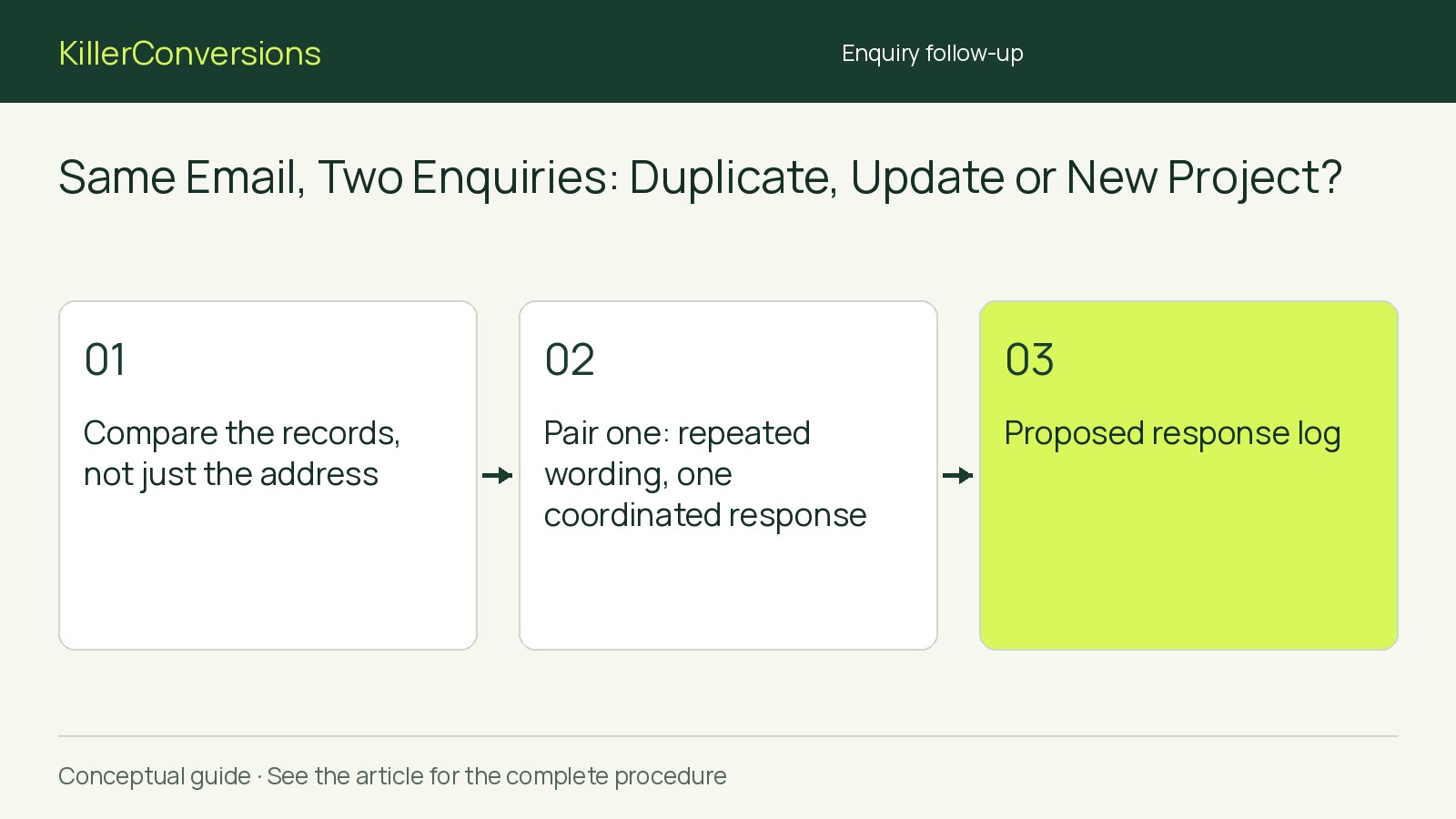
When two stored enquiries have the same email address, compare the project details and requested work before deciding how to respond. Coordinate one response for a likely repeat, confirm changes before using revised instructions, and keep separate projects active. If the relationship is unclear, leave it unresolved and assign someone to clarify.
A matching email is a review clue, not verified identity or permission to disclose earlier enquiry details. Preserve both original submissions under your existing retention policy. Do not silently merge records, overwrite instructions or delete an apparent duplicate based on the address alone.
Compare the records, not just the address
Open both stored enquiries and any correspondence you are authorised to review. Compare:
- Project name, website or requested deliverable.
- Scope, budget, timing and other constraints.
- Wording that explicitly describes a correction, replacement or separate request.
- Submission timestamps, including their time zone, and any replies already recorded.
Close timestamps can support a likely-repeat interpretation, but they do not prove one. A later timestamp establishes order, not authority to replace earlier instructions.
Keep a private follow-up log with record references instead of copying whole messages or attachments. Use your existing restricted workspace; no particular form tool is needed. Track each response as planned or sent, adding the sent date and correspondence reference only after sending.
All pairs and proposed log entries below are hypothetical, not customer results or completed follow-up. The four-minute gap in the first example is not a universal duplicate-detection threshold.
Pair one: repeated wording, one coordinated response
Suppose A1 requests a six-page website for Project Oak. A2 arrives four minutes later with the same project name, wording, budget answer and deadline. Neither record has a staff reply attached to it, and the shared correspondence history contains no response.
There is no visible change in the request. Treating the pair as a likely repeat is reasonable for coordinating follow-up. Identical wording does not establish whether a browser retry, an accidental second submission or something else caused it.
Assign one person to handle the response, with a private reference explaining that both records are being reviewed together. Avoid dismissive wording such as “You already submitted this.”
Proposed response log
- Records and evidence: A1 and A2; matching project details and wording, four minutes apart, no recorded reply.
- Relationship: Likely repeat; cause unconfirmed.
- Current request: Both contain the same six-page brief; no changed instructions identified.
- Reply owner: Jo, responsible for reviewing both records before responding.
- Next action: Send one neutral acknowledgment through the approved contact process.
- Response state: Acknowledgment planned; not sent.
The useful outcome is coordinated follow-up, not fewer stored records. Only mark both as covered by the response once it has actually been sent and logged against the pair.
Pair two: revised scope, instructions still need confirmation
Suppose B1 requests a six-page brochure website for Project Cedar. B2 uses the same submitted email address and project name but says, “Please change this to ten pages and include appointment booking.”
That wording supports a possible update, not a duplicate. Preparing a quote from B1 alone would overlook material information about the work requested.
But silently treating B2 as the complete replacement also creates uncertainty. Does the earlier deadline still apply? Was the original budget intended to cover the expanded work? Is the person giving revised instructions authorised to do so?
Ask for a complete current brief through the appropriate contact process before preparing the quote.
Proposed response log
- Records and evidence: B1 and B2; matching project name, with explicit change wording and added requirements in B2.
- Relationship: Possible update requiring confirmation.
- Current instructions: Unresolved; scope, budget and deadline need confirmation together.
- Reply owner: Sam, responsible for the project clarification.
- Next action: Confirm the intended current brief and appropriate authority before preparing the quote.
- Response state: Clarification request planned; not sent.
Once clarification arrives, add its date and reference to the working log and state which instructions apply. This distinguishes what was originally submitted from what was subsequently confirmed.
Pair three: one address, two active projects
Suppose C1 requests ongoing support for an existing website. C2 contains the same submitted email address but asks for a standalone recruitment campaign page, identifies a different project and explicitly says it is a separate request.
The evidence supports separate projects. Combining them could leave one request without an owner or incorrectly carry a budget or deadline from one project into the other.
Keep two active follow-up paths. They may have the same owner, but each project needs its own next action. If different staff members handle them, coordinate the subject and scope of each reply.
Proposed response log
- Records and evidence: C1 concerns ongoing support; C2 names a separate recruitment project and requests a different deliverable.
- Relationship: Separate projects based on the submitted descriptions, not the email match.
- Current requests: Review each brief independently; do not transfer constraints or approval between them.
- Reply owners: Mira for C1 website support; Leon for C2 recruitment page.
- Next action for C1: Mira reviews the support brief and requests any missing task or timing details before proposing support.
- Next action for C2: Leon confirms the campaign page requirements and launch date before preparing its quote.
- Response state: Both project replies planned; neither sent.
Clarify uncertainty, then check the handoff
When the relationship remains unclear, use wording that does not reveal an earlier submission:
“For the request you want us to work on now, please confirm the project name, required work, target date and, where relevant, budget. If the budget is undecided, please say so. Is this an update to an existing request or a separate project?”
Confirm material constraints rather than silently carrying them forward because the new message omits them.
Use your established identity and authority checks before sharing previous content or accepting consequential changes. Receiving an email reply alone does not prove authority over another enquiry.
Before handing over the pair:
Choose one ambiguous pair and complete its log. A colleague should be able to tell what is known, what still needs clarification and who will act next.