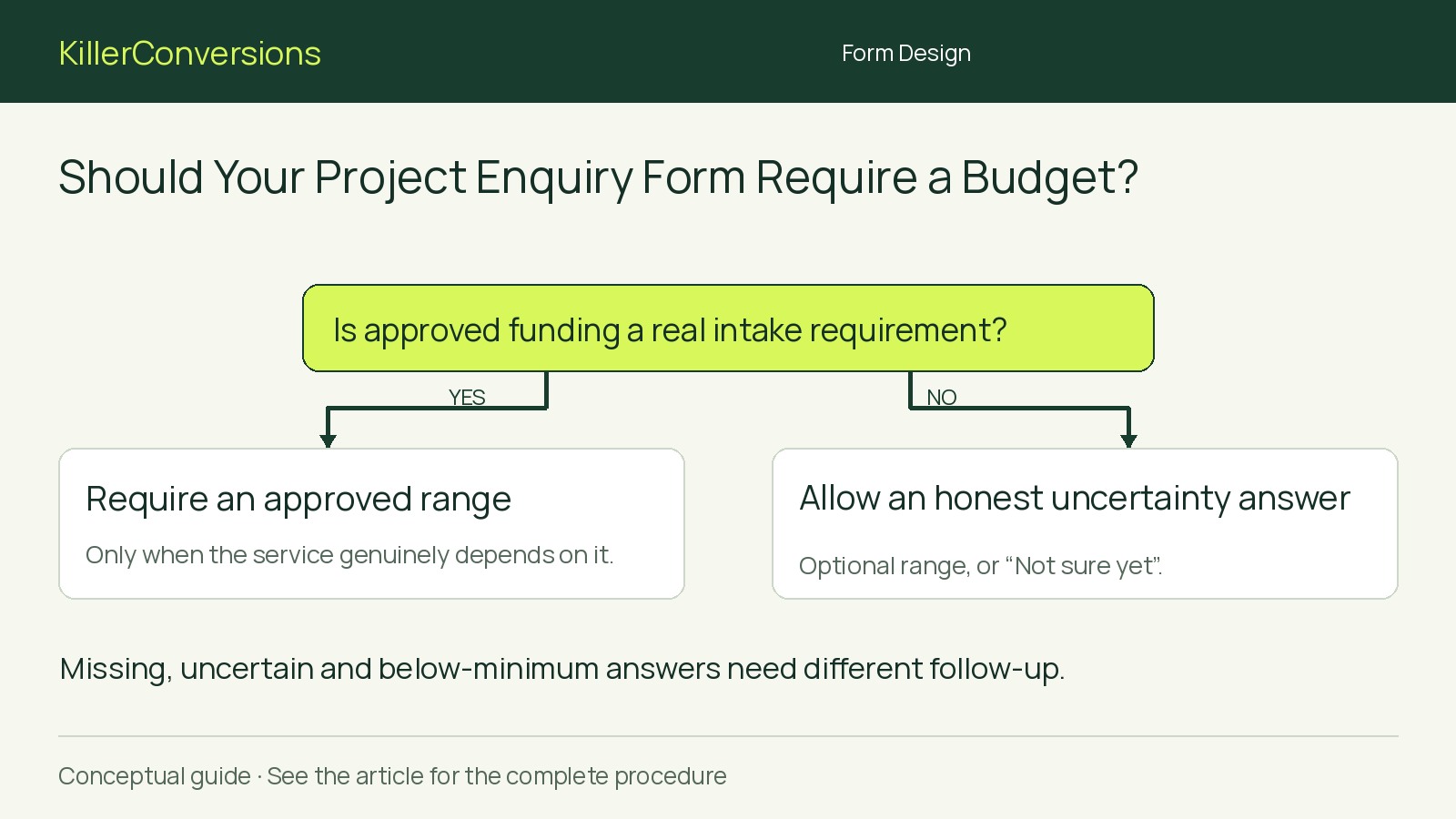
For a project enquiry that leads to scoping, ask for an honest answer, not an invented number. If visitors can enquire before funding is approved, make the budget question optional or require a selection with an uncertainty option. Reserve a required approved range for intake that genuinely depends on approved funding and disclosure of a range.
Start by asking your team: What would we do differently with each answer? If budget information would not change the next conversation, consider leaving it out of the initial form.
Separate a genuine minimum from a preferred project size
A minimum engagement price is an actual constraint: the business does not undertake the defined service below that amount. A preferred project size is a sales preference. Do not present one as the other.
Confirm the policy with whoever approves projects. Establish which service it covers and whether it refers to the whole engagement, an initial phase or recurring work. A full implementation and a separately offered discovery service may have different minimums.
If a genuine minimum applies, explain it before the budget question. Visitors should not have to infer it from the lowest selectable range.
A minimum price alone does not justify requiring approved funding. Someone may need help defining scope before requesting approval. An unknown budget is not zero, and an amount above your minimum does not establish project fit.
Choose what visitors must answer
Use these three rules to select the field setting:
- Require an approved range when approval and disclosure are prerequisites. Explain that condition before the form. Offer an earlier-stage enquiry route only if one actually exists; otherwise, make clear who this form is for.
- Make the field optional when budget is useful but not necessary. Say why you ask. A blank cannot tell staff whether the visitor overlooked the question, lacks a figure or chose not to share it.
- Require a status selection when the next step depends on the visitor’s situation. Include nonnumeric choices for provisional funding and estimation help, with a defined staff response for each.
If visitors who know their budget but prefer not to disclose it remain eligible, allow a blank or offer “I prefer not to disclose a budget.” Uncertainty and non-disclosure are different answers.
Write a question with a clear spending basis
Specify the currency and what the amount covers. “What is your budget?” could mean a monthly allowance, the full project cost or just your fees.
The following is a hypothetical specification, not a recommended minimum or set of ranges. Assume an agency has a genuine USD 5,000 minimum for a defined one-off service, accepts enquiries before funding approval and permits non-disclosure.
Setting: Required selection, with no answer preselected. Every listed option may be submitted for review.
Introductory wording: “Our engagements for this service start at USD 5,000. We can discuss scope before you have an approved budget. Submitting an enquiry does not confirm project acceptance.”
Label: “Which best describes the budget for our work on this project? (USD)”
Help text: “Choose an approved range or the description that fits your situation. Amounts should cover our one-off project fees, excluding ongoing hosting, advertising and other third-party costs. Your answer helps us plan the discussion; it is not a quotation.”
Options:
- Approved: below USD 5,000
- Approved: USD 5,000 to under USD 10,000
- Approved: USD 10,000 or more
- I have a provisional figure, but it is not approved
- I need help estimating the budget
- I prefer not to disclose a budget
The ranges do not overlap, and the nonnumeric choices let visitors answer without claiming approved funding.
Replace the amounts and spending basis with your actual policy. For recurring services, state the spending period. If you need both setup and ongoing budgets, ask separate questions rather than mixing them in one range.
Give each answer a distinct staff response
Assign an intake owner and agree on the next action for each answer before publishing. These fictional enquiries illustrate proposed responses, not observed results.
Enquiry A selects “I need help estimating the budget.” The intake owner asks about intended outcomes, essential requirements and timing, then explains what further scoping is needed to discuss a useful price range. The answer does not justify treating the enquiry as below minimum.
Enquiry B selects “Approved: below USD 5,000” and confirms USD 4,000 in its message. The intake owner declines the requested service at that budget. Reducing its scope does not remove the stated USD 5,000 minimum.
A separately offered service is an alternative only if its scope meets the visitor’s needs and its proposed price is both at or above its own minimum and no more than USD 4,000. Do not imply that a cheaper route exists if the business does not offer one.
Define the remaining responses just as explicitly:
- Missing: In an optional-field version, record that no information was provided. Ask only if needed for the next step.
- Provisional: Discuss the scope and information needed for approval; do not treat a provisional figure as committed spending.
- Not disclosed: Continue with scope questions and explain any later point at which funding confirmation becomes necessary.
- Approved range at or above minimum: Confirm what the amount includes and whether the requested scope is plausible before discussing a quotation.
Keep these as intake categories, not automatic lead-quality scores.
Test the question and the handoff
Use fictional details in a test version of the form. Check both the visitor’s choices and the information staff can actually review.
Resolve lost or altered answers before launch. If the intake owner cannot choose the next step from the record, revise the wording or follow-up rule, then repeat the affected test.